

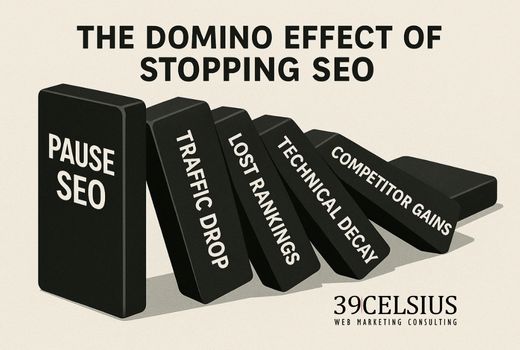
Is SEO a finish line or a continuous journey? Many businesses, after achieving initial organic success, assume the work is done. They view SEO as a project to be completed, not a system to be maintained. This common misconception often leads to a fatal decision: stopping their SEO efforts.
The reality, proven by data time and time again, is that stopping or pausing SEO efforts inevitably leads to a decline in organic visibility, traffic, and keyword rankings, often making the recovery more difficult and costly than simply maintaining the effort.
We’re sharing two powerful client case studies that demonstrate the true cost of pausing SEO and why, in the age of AI, a strong SEO foundation is more critical than ever.
Quick Answers to Your Top Questions
No, you cannot. SEO is a "competitive marathon, not a sprint." Your competitors do not stop optimizing, and pausing your efforts allows them to quickly surpass you, causing your rankings and traffic to decline sharply. Stopping also makes your site vulnerable to the next algorithm update, as you won't be monitoring or adapting to Google's changes.
No, it is generally more expensive in the long run. Stopping SEO creates a "deficit" and forces you to pay a "catch-up tax" later. Restarting SEO requires significantly more effort and time than maintaining the momentum would have, and you may still be unable to fully recover your previous high traffic levels months after restarting. You lose the Compound Effect of continuous effort.
It makes a strong SEO foundation more critical, not less. The "AI Revolution Rests on SEO." AI Chatbots and new Generative AI search results pull information from websites that Google trusts. If you cease technical maintenance and content updates, your site’s authority degrades, meaning you will have poor visibility and inclusion in the future of AI chat results. All search traffic still points back to a trusted source, and SEO establishes that trust.
The biggest risk is technical decay and vulnerability to site issues. When monitoring stops, a simple, non-SEO-related platform update could unexpectedly wipe out your Schema Markup. This causes a massive loss of high-value keywords and SERP features. Without continuous SEO, you are blind to critical technical errors that can silently damage your organic performance and cause significant traffic loss.
Watch a video or audio of this post:
Prefer to listen to the audio file?
Click to listen or download the file.
Case Study 1: The Mouthguard Company – The Difficulty of Recovery
This case study is a classic example of achieving phenomenal ROI only to jeopardize it with a pause. (Full SEO Case Study). This company was an ecommerce, direct-to-consumer brand that provided custom-made dental nightguards.


Discover How Our Agency Can Drive More Leads and Sales To You
SEO - increase traffic and leads from Google
Content Marketing - from a data-driven topic strategy to awesome content
Paid Ads - Google Ads and Paid Social Media
SEO Success: Peak ROI
For almost 2 years, our SEO-driven content creation, technical audits, and link-building efforts grew significant momentum. The site grew fantastic organic rankings, driving high-converting traffic and generating an exceptionally high ROI.

New Organic Search Users by Month Trending
From the chart below, you can see that after approximately six months of consistent SEO effort, the ROI took off, increasing four times over the next six months. This is a common payoff trend for SEO - it takes time to build, but then the return on investment rises significantly.

SEO ROI Trending by Month for 12 Months
The Power of Momentum:
Consistent SEO builds a virtuous cycle. Every new piece of content provides a reason for the search engine to come back to your site, and every new quality backlink reinforces the site’s authority.
This SEO momentum helps a site naturally ride out algorithm changes without a continuing decline.
The Decision to Pause: The Drop
Angel investment backed this business, and pressure grew to increase profitability. Unfortunately, the CEO stopped investing in SEO and content, believing he could ride the SEO momentum and hit overall profit goals.
Google's Algorithm Updates
Google regularly updates its search algorithm, and this can significantly impact your site's traffic positively or negatively. The only way to navigate through Google's updates is to monitor the effects of the algorithm updates and adjust your SEO strategy accordingly.
However, when you stop SEO efforts, you are no longer adapting to changes, and the site's content becomes stale, resulting in a drop in rankings and traffic.
In just 3 months after we stopped SEO and content, the site's traffic was cut to a third:

The resulting drop in key metrics—traffic, high-value keyword rankings, and visibility—was swift and severe.
Future-Proof Your Content: Addressing the 20% of Unique Daily Searches
Compounding the organic traffic decline is the fact that 20% of the searches Google sees in a day it has never seen before. So, if you're not producing fresh content, you have a limited ability to capture those searches.
Why the immediate decline?
- 1Competitors didn't stop. Rivals continued publishing content, earning links, and optimizing, effectively pushing the client lower in the organic search results.
- 2No Adaptation to algorithm changes: In the fast-moving digital marketing world, if you stand still, you fall behind. With no one monitoring, the site was blind to changes and new opportunities.
- 3The Brand Went Organically Silent: The lack of fresh, optimized content signaled a decline in relevance to search engines.
The Restart and The Struggle
The client eventually realized the mistake and restarted SEO, but the recovery has been an uphill battle.

It requires significantly more effort and time to climb back up than it did to get to the initial peak. Momentum was lost. Even months after restarting content, the site is currently experiencing less than half the traffic it had previously.

Toby Danylchuk
When you stop SEO, you lose momentum. Competitors overtake you.
Watch my YouTube playlist all about SEO .
Conclusion for Case 1:
Stopping SEO doesn't save money; it simply creates a deficit that must be filled later at a higher effective cost. You pay a "catch-up tax" on the momentum you lost.
Discover How Our Agency Can Drive More Leads and Sales To You
SEO - increase traffic and leads from Google
Content Marketing - from a data-driven topic strategy to awesome content
Paid Ads - Google Ads and Paid Social Media
Case Study 2: The Wedding Venue – The Technical Decay
This example perfectly illustrates the slow, steady erosion of organic SEO assets and the danger of unmonitored technical SEO.
The Organic Baseline (December 10, 2024)
Before the client paused our SEO and content efforts, the wedding venue had a healthy organic footprint with 11,476 ranking keywords:

Keywords Ranking
The organic traffic chart confirms the site was performing well, riding high on a strong content and keyword base.
The Pause and Decline in Visibility
The decision to stop monitoring led to a steady, visible decline in the Organic Traffic and Organic Keywords charts from late 2024 through 2025. Every keyword ranking band—Top 3 positions, positions 4-10, positions 11-20—saw a gradual and sustained drop.

The venue lost 321 high-value keywords (positions 1-20) and over 4,000 total keyword positions—a massive drop in visibility and potential leads.
The Technical Decay: A Critical Lesson

Number of Keywords Ranking
The most alarming finding was the underlying cause of much of the loss: Technical Neglect.
When SEO efforts were paused, an automatic platform update was installed. This update, completely unrelated to SEO, wiped out the site’s crucial Schema Markup.
Schema markup is the code that helps search engines understand your content to generate SERP Features (like rich snippets, site links, and FAQ boxes). Its removal immediately hurt the site’s ability to earn these features.
This highlights a key truth:
A website is a living piece of software. Without continuous monitoring, even a small technical change can remove the foundational elements of your organic success.
Key Takeaways: Why SEO Must Be Continuous
These case studies offer critical and actionable lessons for any business that relies on organic traffic. The data from the mouthguard company and the wedding venue prove that in the digital world, standing still is the fastest way to fall behind. SEO is not a set it and forget.
Industry Data: What Happens When You Stop Blogging
Our client results aren’t isolated. Independent research confirms a similar pattern across multiple industries.
According to NP Digital’s October 2025 Content Marketing Insights, which analyzed 20 companies (10 that kept blogging and 10 that stopped) over a 12-month period, the performance gap between continuous and paused SEO efforts is dramatic:
 What Happens When You Stop Blogging
- SEO Traffic: Companies that stopped blogging saw a 39.7% drop, compared to only an 18.2% dip for those that continued publishing SEO-optimized content.
- LLM Traffic (AI-related visibility): Businesses that continued producing content saw an 85.8% increase in traffic from LLMs, versus just 6.5% for those that stopped.
- Revenue Growth: Those who kept blogging achieved a 9.1% increase in sales, while those who paused saw a 10.4% decline.

Adapted from data presented in NP Digital via Email, Oct 29, 2025
These data reinforce what we’ve seen firsthand: pausing SEO and content creation doesn’t just halt progress—it reverses it. Regular publishing sustains rankings, supports AI visibility, and drives steady revenue growth.
Actionable Takeaways
The Search Landscape is Always Changing: The Cost of Missing New Opportunities
It's tempting to think that once you've captured the top keywords, the work is over. However, search engines—and human search behavior—are constantly evolving targets.
SEO is a Competitive Marathon, Not a Sprint
Your organic ranking is relative to your competitors. It's a continuous contest where the players who consistently show up, win.
The Compound Effect: Don't Kill Your Momentum
SEO is often compared to compound interest, and for good reason. Every consistent effort builds upon the last.
Maintenance is Vital: Guarding Against Technical Debt
The wedding venue case is a powerful cautionary tale against believing that a website, once optimized, will remain so forever.
Invest for Long-Term Stability
SEO consistently produces one of the highest returns on investment (ROI) out of any marketing tactic.
Why?
Because you are building a proprietary, high-converting, long-term asset.
View your SEO and content strategy not as an expense that can be cut, but as a fundamental, non-negotiable investment in your digital infrastructure—akin to keeping your website online or paying for essential software.
If you don't put the gas in the engine, you won't just coast; you will come to a screeching, costly halt at best or crash and burn at the worst.
