

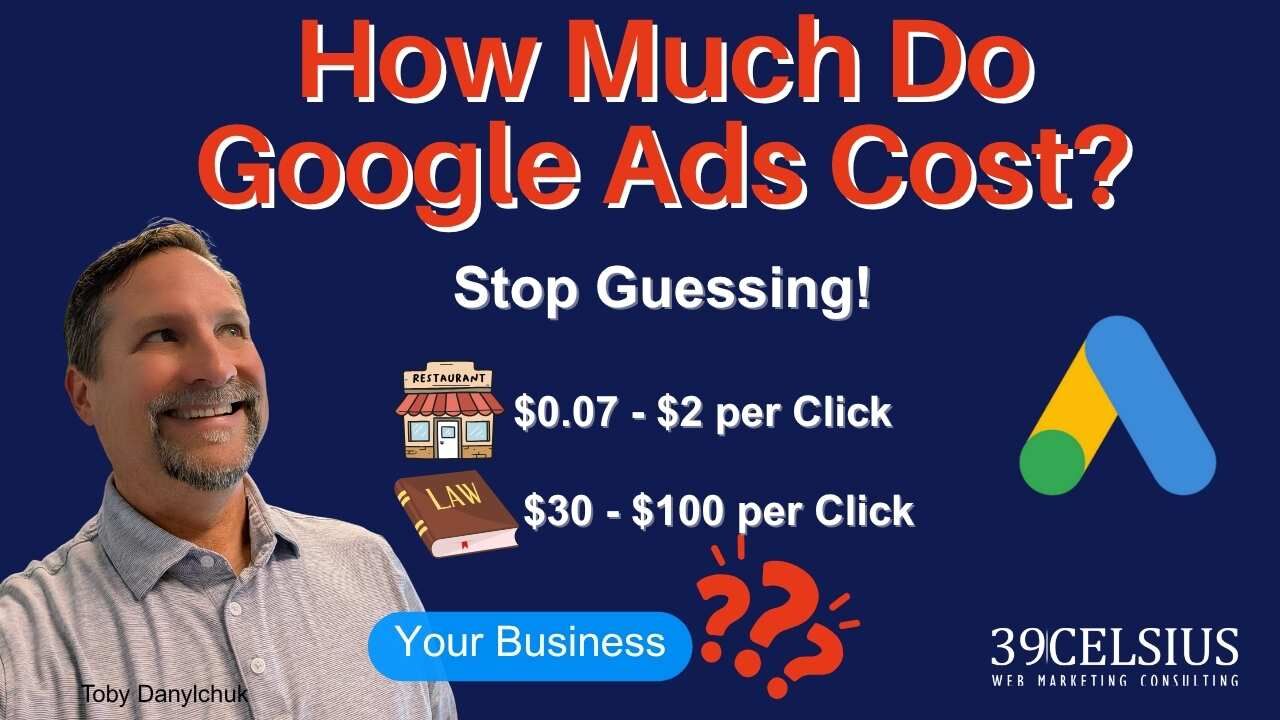
Stop guessing! You’re considering Google Ads, but you have one big question: How much will it cost you?
If you've wasted money on other advertising that didn't pay off, you need to know exactly how Google Ads pricing works before you spend a dime. I'll break down the actual costs and show you how to spend less for bigger results.
In this post, our goal is to help you understand the hidden factors that impact your Cost Per Click (CPC) and show you how to leverage ad quality to spend less and get a real return on your investment. We're going to break down the true cost drivers and show you how to make informed decisions about where you should put your ad dollars and effort.
Let's start with the basics.
Quick Answers to Your Top Questions
Typically, $2.00 to $5.00 for search ads but depends heavily on the industry you're in and can go higher than $100 per click. The average CPC is lower for display ads.
One way to lower your Google Ads CPC (without reducing your budget) is by maximizing your Quality Score (QS). By improving ad and landing page relevance, you earn a lower CPC and higher ad placement from Google.
Cost per click is a signal for economic value to advertisers. Advertisers pay more because a single customer acquisition in niches like law or finance can generate millions in revenue so advertisers can afford to bid up the cost per click.
the main hidden costs are management fees and the cost of poor campaign structure. Inefficiency quickly wastes far more money than the cost of hiring an expert or agency.
Yes, absolutely.
Landing page relevance and speed are major Quality Score factors. A poor page lowers your QS, leading to higher CPC and wasted budget.
QS (1-10) is Google's measure of relevance for Ad Rank. A high QS lets you pay less per click and still outrank a competitor who bids higher but has lower ad quality.
Focus on long-tail keywords. These specific, longer search phrases show clearer purchase intent, resulting in more qualified, higher-converting clicks that maximize your ROI.
Watch a video or audio of this post:
Prefer to listen to the audio file?
Click to listen or download the file.
Your First Lesson: What You Really Pay For in Google Ads
Too many small businesses treat Google Ads like a black box. The fundamental concept you must grasp is Cost Per Click (CPC).
You don't pay just for your ad to be seen; you only pay when someone clicks on your ad and visits your website. This is a huge benefit because you are paying only for proven interest from a high-intent searcher. This is why the cost of a click isn't the most important metric: your return on that click is what matters (ROI, ROAS).
The average cost per click (CPC) for small businesses on the Google Search Network typically falls in the range of $2.00 to $5.25. However, this number is highly dynamic. Costs can be much lower for display ads or local services and significantly higher (up to $100 or more) in competitive, high-value industries like law or finance, where the potential customer profit is much greater.

The Lightning-Fast Google Auction System Explained
How is that dynamic price per click decided? It happens in a lightning-fast Google auction system that occurs every time someone searches. Your daily budget influences the bid Google places on your behalf, but here’s the crucial point: the highest budget doesn't always win.
The most effective way to lower your CPC is by dramatically increasing your Quality Score (QS). Quality Score measures how relevant your ad and landing page are to the user’s search. By improving relevance, Google rewards you with a lower CPC and higher ad placement, effectively helping you spend less for a better result.
The Game Changer: Why Quality Score Matters More Than Money
If you learn nothing else from this post, learn this: The single greatest variable you control that directly impacts your cost is your Quality Score (QS).

Quality Score and Cost per Click Relationship
Google uses a formula called Ad Rank to determine where your ad shows up. This Ad Rank is the secret formula that determines who wins the auction. It looks at your bid, but far more importantly, it examines your Quality Score—a rating from 1 to 10 that measures how relevant and useful your ad and landing page are to the person searching.
The principle is simple: Google rewards good advertisers with lower costs and more exposure, making it your key to profitability.
Quality Score is a diagnostic rating (1-10) used by Google to determine Ad Rank. A score of 1 is the lowest, and a score of 10 is the highest. Quality score is shown at the keyword level of a Search campaign. It measures your ad's relevance, expected click-through rate, and landing page experience. In the ad auction, a high Quality Score enables you to pay less per click while still ranking higher than a competitor with a larger bid but a lower Quality Score.

Discover How Our Agency Can Drive More Leads and Sales To You
SEO - increase traffic and leads from Google
Content Marketing - from a data-driven topic strategy to awesome content
Paid Ads - Google Ads and Paid Social Media
The 3 Variables That Instantly Change Your Click Cost
Your actual cost per click isn't set in stone; it changes all the time and is influenced by these three main factors...
1
Factor 1: Industry Competitiveness and the Cost Signal
The value of a customer in your industry directly influences your cost per click. This is the economic value signal. If prospects are more valuable, advertisers are willing to pay more per click to win a customer.
To see what those click costs turn into at the business level, here's a Google Ads case study for a massage spa – 606 conversions in 30 days at $4.90 each on a $3,000/month budget.
Here's an example of the cost per click for various keywords in the personal injury law niche (a single case can be worth millions so advertisers are willing to bid up the CPC):

Personal Injury Lawyer Keywords with High Average Cost Per Click Example
Don't fear high CPCs; they indicate a high-value customer. Focus on the return, not just the expense.
The truth is simple: Google's auction isn't about vanity; it's about profit. The only reason an advertiser will pay $100 for a click is because they know (with high certainty) that the resulting customer is worth far more.
Here are the three factors driving that elite-level price tag:
- The Customer is a Goldmine (High Lifetime Value):
This is the biggest one. If one new client can net your business tens of thousands of dollars (think a major lawsuit, a large enterprise software contract, or a high-premium insurance policy), a $150 click is actually a bargain. Industries like Legal, Finance, and high-value B2B live here. - Urgency and Buying Intent are Maxed Out:
The expensive keywords aren't generic. They signal the searcher is at the very end of their buying journey and needs a solution now. Examples are terms like "emergency water damage restoration" or "DUI lawyer near me." When a user is in crisis, the value of that click skyrockets. - Everybody Wants That Action (Extreme Competition):
In these lucrative niches, every major player is bidding with a large budget. This intense, sustained competition for the top ad position drives the price ceiling upward. You're not just bidding against one company; you’re bidding against an entire industry that can afford to pay a premium.
2
Factor 2: Target Audience & Geography
Targeting major metro areas (New York, Los Angeles, Chicago) costs more because the competition is fierce.
The larger the population and the higher the density of competing advertisers, the more expensive your clicks become.
This is because you eliminate competition from national players and large companies that aren't focused on your hyper-local market. Always narrow your geographic targeting to your genuine service area to maximize your budget and minimize wasted ad spend.
To improve lead quality, focus on using long-tail keywords (longer, more specific search phrases) instead of simple, broad terms. Long-tail keywords indicate higher purchase or service intent, leading to more qualified clicks that convert, maximizing your ultimate ROI instead of just focusing on the click cost.
3
Factor 3: The Long-Tail Keyword Strategy
Don't waste money bidding on simple, competitive keywords (like "plumber") that are vague (the actual search intent is not clear) and expensive.
Focus instead on long-tail keywords. These are longer, more specific phrases that demonstrate clear intent, such as:
These phrases have less competition, generally cost less per click, and, most importantly, bring in more qualified leads because the user's need is clear. You can find detailed bid estimates for long-tail keywords using the free Google Ads Keyword Planner Tool.
Calculating Your True Google Ads Investment
You now understand that your Cost Per Click is dynamic, but your overall Google Ads investment extends beyond just the click price. While the average CPC for small businesses on the Search Network often falls in the range of $2 to $5.25, this click cost is only one piece of the investment puzzle. To budget correctly, you must factor in the two other essential hidden costs:
Calculating Your True Google Ads Investment: Beyond CPC
Crucial Investment 1: Expert Management
If you hire a professional agency (like us), they typically charge a management fee (often 10% to 30% of your total ad spend). For a small business, this expertise is often worth it because a poorly run campaign will waste your budget faster than any agency fee you pay.

Toby Danylchuk
Successful Marketing Boils Down to two things:
"Getting the right people to your website, and then effectively turning those visitors into potential customers and sales."
Absolutely. Your website's loading speed, relevance, and user experience directly impact the Landing Page Experience component of your Quality Score. A poor or irrelevant landing page will lower your Quality Score, leading to higher CPC costs and unnecessary wasted budget.
Crucial Investment 2: Landing Page Alignment
Remember that Quality Score? It cares deeply about your landing page. This is the surprising way a great website can lower your ad spend.
A best practice:
segment your ad groups logically based on types of services. If you shove all your services onto a single generic page, your Quality Score suffers, and you will waste marketing dollars. A Home page is often one of the worst pages to send traffic to.
For more on this critical connection, read our detailed post: PPC Landing Page Best Practices
Your Ultimate Goal: Maximizing Profit & Return
Your goal isn't to get the cheapest click; it’s to maximize your ROI. This means understanding your Target CPA (Cost Per Acquisition), which is how much you can afford to pay to acquire a new customer.
How to Set a Profitable Starting Budget
For the detailed methods to calculate your ideal monthly ad spend, including budgeting based on growth stage, sales goals, or industry benchmarks, please refer to my related post: How Much Should I Spend On Google Ads (PPC)?.
Maximize Your Google Ads ROI With A Small Budget
Small Budget? Use These Smart Tactics to Win
If you have a small budget, you can still win. Use smart tactics like dayparting to focus your spend. Dayparting involves setting the specific days and times you want your ads to run. Instead of spreading a small budget thinly over 24 hours a day, you concentrate your spending on the most profitable times to maximize every dollar.
Beyond the actual click cost, the two most common hidden costs are management fees (if hiring an agency) and the cost of poor campaign structure. A poorly managed campaign can quickly waste 10 times more money in irrelevant clicks than you would pay for professional management.
For an in-depth guide on making a small budget count, check out: Low Budget Google Ads Strategies: 10 Ad Hacks.
The Most Critical Step: Setting Up Your Digital Plumbing
I don’t care how beautiful your website or landing page is. If you don't have this step right, your campaigns will fail to deliver profit. To run truly profitable campaigns, you must have your digital plumbing (conversion tracking) set up.
This is the crucial step: set up your digital plumbing (conversion tracking).

Setting Up Your Digital Plumbing
This means you have set up communication channels between your landing page and Google Ads so that Google knows exactly which conversion actions are most important to you (form submissions, phone calls, online sales, etc.).
When this is set up correctly, Google Ads will optimize to deliver more of the conversions that are most important to you, maximizing your profit. Don't start a campaign without it.
Read our step-by-step guide: Google Ads Conversion Tracking - Don’t Start Without It.
Conclusion & Next Steps: Your Clear Path to Google Ads Profit
Is Google Ads worth the money?
Absolutely, yes.
The cost of Google Ads is not a fixed number; it’s a dynamic investment that you control. By focusing on Quality Scores and selecting highly specific long-tail keywords, you can beat the competition, pay less per click, and produce more sales and profit.
If you are ready to stop feeling lost in the digital marketing maze and are prepared to start implementing a clear, personalized digital marketing strategy that directly impacts your sales and profits, let's talk.
Don't let the fear of costs hold you back from reaching new customers.
The key takeaway is this...
You do not win in Google Ads by chasing cheap clicks. You win by focusing on ROI, relevance, and intent.
Every dollar you spend should be traceable to measurable outcomes such as calls, form submissions, sales, or website visits. With the right tracking setup, often referred to as your digital plumbing, Google can help you find more of the customers who actually convert.
For business owners, the most profitable campaigns always start with clarity. To optimize your ad performance, you need to know your target cost per acquisition (CPA), understand your local market dynamics, and align every ad group with a specific customer intent. When these elements work together, Google Ads becomes a predictable, scalable growth engine instead of a guessing game.
